
by Diana Studer
- gardening for biodiversity
November 2009 we returned to our burnt mountain. Since the March fire we had winter rain, and the mountain slopes were green, with unbroken drifts of colour from scarlet Watsonia. With the shrubs gone, annuals and bulbs celebrate their field day. Gradually the perennials and trees in the kloofs will grow back and crowd them out, until the next fire.

The restios and grasses look so inviting for the buck, which would have been driven to the edge of the fire, and struggled to find shelter and food. Ficinia radiata, a sedge, scattered the whole Groot Winterhoek Wilderness Area with gold stars for Christmas!
 |
| Groot Winterhoek November 2009 after fire |
From PlantZAfrica - In the genus Ficinia almost all 60 species are endemic to the Cape Floristic Region. Ficinia is a characteristic genus of the Cape fynbos. Thirty-three species in the Cape Peninsula alone. An elaiosome (the appendage on the seed that is rich in oil) attracts ants, that drag the seed into their nests underground. The ants eat the elaiosome and leave the seed in the nest, where it can germinate safely. In the fire-dependant Cape flora this is important as the seed is also protected from the heat of the burn.
 |
| Dilatris pillansii |
Dilatris pillansii was new to me. Misty mauve flowers floating about half a metre above the ground. But many flowering plants are only seen, with the first rain after a fire.
 |
| Groot Winterhoek November 2009 |
On our burnt mountain we saw swathes of colour. Getting closer, two plants dominated. Golden yellow Wachendorfia paniculata.
 |
| Wachendorfia paniculata |
From PlantZAfrica - The pollinator is unknown and its pollination biology is a bit of an evolutionary puzzle. The flowers produce a generous amount of nectar that is easily stolen, with the thief not having to get anywhere near the pollen or stigmas in order to get at the nectar. The black seeds are hard but light in weight and are densely covered in short coarse hairs which give the seeds a fuzzy outline. They also float on water, and given the riverine habitat of the plant, this is probably an adaptation for water dispersal. The Haemodoraceae, or bloodwort family, gets its rather alarming name from the red cell-sap found in the roots which colours the rootstock red (haima is Greek for blood). Haemodorum is the Australian genus on which this family is based. The Australian Anigozanthos is the kangaroo's paw.
 |
| Geissorhiza sp. |
Not as dominant, were clusters of apricot Geissorhiza, from the iris family.
 |
| Sundew |
On the patches which are still exposed from the fire, the ‘soil’ is gritty blinding white quartz gravel. From the Table Mountain Sandstone. This is not fertile and the sundews supplement their meagre diet with insects.
 |
| Morea neglecta with ant |
Ants are vital to the survival of the fynbos. This ant is on a Moraea neglecta flower.
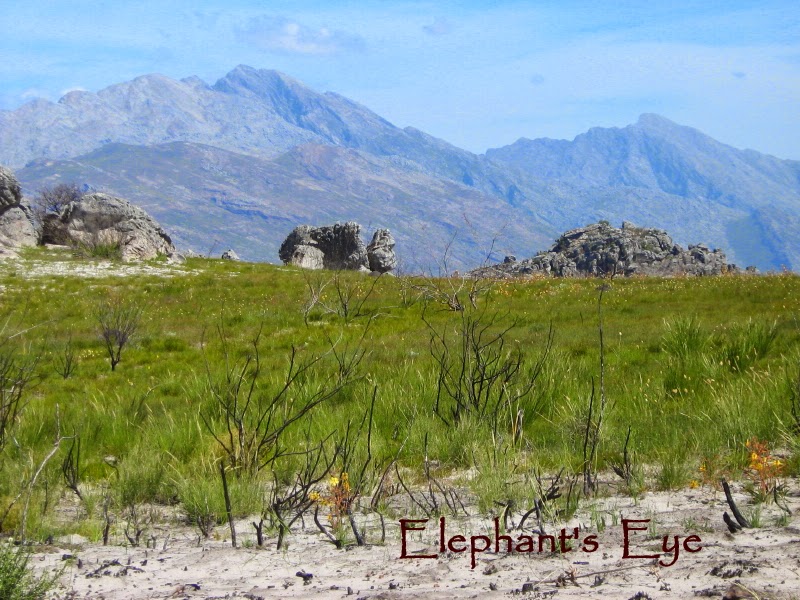 |
| Groot Winterhoek November 2009 |
A lingering gaze at the Groot and Klein Winterhoek. With snow in June 2013. Sunshine and firelight in August 2014.
 |
| Disa atricapilla |
Porterville is famous for yellow disas. Sadly most of that colony were poached, so I was loath to show these pictures of Disa atricapilla when they were in bloom. Now I hope the plants are safe!
In November 2009 Carrie wrote - It always amazes me what beauty comes out of fires in nature. Makes me think that we as people should have a cleansing of the clutter and the choking stress that takes all our light and room to grow. Maybe underneath we too have an aray of simple little pleasures that just needed space to show themselves and brighten our world. That fits me well, as we are days away from living on False Bay.
In November 2009 Carrie wrote - It always amazes me what beauty comes out of fires in nature. Makes me think that we as people should have a cleansing of the clutter and the choking stress that takes all our light and room to grow. Maybe underneath we too have an aray of simple little pleasures that just needed space to show themselves and brighten our world. That fits me well, as we are days away from living on False Bay.

(in Porterville, near Cape Town in South Africa)
(If you mouse over brown text, it turns shriek pink. Those are my links.
To read or leave comments, either click the word Comments below,
or click this post's title)


Such resilience and diversity. The yellow disa is beautiful.
ReplyDeleteIt's amazing what pops up after a fire! The same thing happens here in our prairies--some of the plants actually need the occasional burn. Thanks for sharing photos of your beautiful wildflowers!
ReplyDeleteAs a plant ecologist who studied wildfires, I know intellectually that they are the phoenixes of ecosystems dependent on fire. Yet I am always astonished by the diversity of plants that appear after a wildfire, including as with your beautiful photos of your fynbos after the 2009 fire. Perhaps your move will be like the fire, bringing you beauty you had never seen before. Blessings!
ReplyDeleteI was not familiar with Disas. So beautiful! And sad that they are poached.
ReplyDeleteIt's a sort of magic to see how plants embrace fire and return in splendour.
ReplyDeleteGreat ant picture, Diana. I always have ants on my peonies -- they are good pollinators. I'm glad you found time to blog. Hope the unpacking and settling in are going well!! P. x
ReplyDeleteDiana, if I read your posts I always learn a lot. And that's also what I realy love!
ReplyDeleteHave a wonderful week
Elisabeth
When you call the Ficinia a sedge, do you mean the sedge family (Carex) we know in North America?
ReplyDeleteours is Cyperaceae.
DeleteThe genus Ficinia of the tribe Scirpeae is remarkable in that almost all of the ± 60 species are endemic to the Cape Floristic Region. Species range from tiny, inconspicuous individuals to the eye-catching 'yellow star' display of Ficinia radiata - from PlantZAfrica
http://www.plantzafrica.com/plantefg/ficinia.htm
It ate my comments...sigh.
ReplyDeleteAnyways, it always amazes me that anything can flourish after a fire, but nature is resiliant isn't it?
Jen
Fires are always shocking, but not everybody knows that its needed for Fynbos every now and then.
ReplyDeleteWow. - what force nature has to spring back with such vigour - I've never seen disa flowers - I hope these are safe from the poachers x
ReplyDeleteThis is why I love nature...how life comes out of fire and the way ants act as pollinators...they do the same for many of my spring native plants. I love the colors of the Disa atricapilla. Nasty how someone poached them.
ReplyDelete