13 January, 2015

We have moved (to a new blog. Pretty Please, update your blogroll)

UPDATE  February 2023
for previous and new subscribers

I invite you to join us at Elephant's Eye on False Bay. Please subscribe as you prefer

via NEW non-Feedburner at  Feedly,

or my Facebook blog page
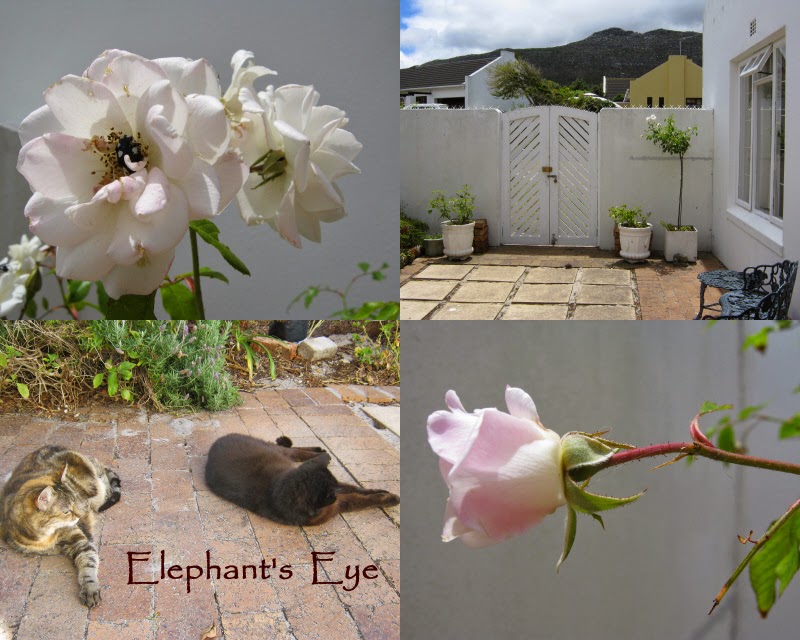

With Janus, the god of doorways,  I look forward at our False Bay garden which changes with each week's work.

Roses and cats in False Bay December 2014

And back at the once was garden in Porterville, where I can trawl five years of Wildflower Wednesday posts, to remember which plants I want around me again.

Blue sage January 2014 in Porterville

PS I would really appreciate if you would update your blogroll, removing the link to this dormant blog and replacing it with a link to the new active False Bay blog - which welcomes both new readers and those who I met over the years on this Porterville blog.

15 December, 2014

Goodbye Elephant's Eye and Blotanical, we are in False Bay

by Diana Studer
- gardening for biodiversity

That disconcerting feeling, something's off, wrong. Why can't I walk down the path? Why is there a TREE in the path?! Our neighbour's Australian acacia was rotten at the base and in the night came to rest gently on the wall, enfolding the last apple tree in its arms. I didn't realise till it was in our garden quite how much tree there was.

Acacia down in June 2013

13 November, 2014

After our mountain fire, flowers

by Diana Studer
- gardening for biodiversity

November 2009 we returned to our burnt mountain. Since the March fire we had winter rain, and the mountain slopes were green, with unbroken drifts of colour from scarlet Watsonia. With the shrubs gone, annuals and bulbs celebrate their field day. Gradually the perennials and trees in the kloofs will grow back and crowd them out, until the next fire.

Ficinia radiata

29 October, 2014

October roses and baby swallows

by Diana Studer
- gardening for biodiversity

I look at boxes. We will be leaving Elephant's Eye and Porterville in November. My last Wildflower Wednesday for Gail at Clay and Limestone from this garden of 8 years in our life. But always there are flowers, even if only two roses in jam jars.

Moving with Duftwolke and Karoo Rose

01 October, 2014

October at Paradise and Roses

 by Diana Studer
- gardening for biodiversity

In a Persian garden

“The word paradise originally meant a hunting park,
and it is still a Persian word for garden. Gardens of the Islamic world,
an oasis. All round stretch bare hills in the burning sun.
Within the garden, cool shade and the sight and sound of water.
High surrounding wall, trees for shade and fruit,
a pavilion, flowers in beds and pots.
Native bulbs, followed by roses. Garden is divided in four"
- slightly modified from Hugh Johnson’s The Principles of Gardening, 1979
This was my inspiration for the rose garden.

Magic-carpet-ride-Persian-gardens history and background

The house and a wall curved around two sides provide seclusion. A low informal hedge of Dusty Miller Centaurea cineraria plumes of velvety grey feathers. A view up to the Olifantskop (Elephant’s Head). We can hear the waterfall. Four paths, the four rivers of paradise – milk and honey, water and wine. An octagon in the centre. As focal points – there are four trees providing dappled shade. Years ago when we saw the White Garden at Sissinghurst, I realised that instead of a random collection of pretty plants – you can compose a living picture.

Preparation for the roses in 2007

24 September, 2014

A Swartland garden in September

by Diana Studer
- gardening for biodiversity

The ash trees are in full ruffled petticoat ball gowns. Morning after the ball, I pick up fallen flounces. Trim as Prince Charles at Highgrove said - send the cows into the park, the trees need trimming. I stretch my arms wide ... and trim to shoulder height. Our maids of the forest have changed from gold flashes on lime to a clear crisp apple green. The plums are veiled in blossom like brides. Tree following.

Ash and plum trees with lavender

27 August, 2014

A Swartland garden in August

by Diana Studer
- gardening for biodiversity

As August unfolds, the aloes open on our Karoo Koppie. The weaver birds bicker over whose turn it is for the nectar. Aloe marlothii  buds are little yellow bananas on maroon stems with prickly leaves. Aloe speciosa has red buds, which fade to white as it opens, with blue leaves. For False Bay I will be looking at Worcester's Karoo Desert National Botanical Garden for smaller aloes. Succulents like Euphorbia, Crassula and Cotyledon - which I'm harvesting for cuttings.

Yellow and red Aloe marlothii
Red and white Aloe speciosa


18 August, 2014

Harvester ants and harvester termites with Malmesbury gousblom

by Diana Studer
- gardening for biodiversity

Harvester ants

Indigenous ants are a vital part of the web of life, especially these harvester ants which live on seeds. At the entrance to the nest is a heap of husks. Some of the seeds which they take underground into their nests are able to grow, and they work at seed dispersal. They live in “dry areas” - Field guide to insects of South Africa, by Mike Picker, Charles Griffiths, and Alan Weaving.

Harvester ants bearing gousblom seeds

05 August, 2014

Sunshine and firelight in the Groot Winterhoek

by Diana Studer
- gardening for biodiversity

Jack at Sequoia Gardens and I were talking about South African indigenous plants with interesting leaf colour. I said grey is easy, but gold and wine-dark are exotic. Jack reminded me that proteas do leaf colour. That was the nudge we needed to go walk on our mountain. Timed it for the Leucadendron to perform.

Sunshine
Leucadendron salignum female

30 July, 2014

A Swartland garden in July

by Diana Studer
- gardening for biodiversity

Our garden decides which colour features thru the year. Red and yellow flames echo the kitchen hearth at the Owl House. I've learnt a deeper love for my blue-green Melianthus major as I see it cherished by Northern foreign gardeners. Theirs is cut down by frost, and mine is bravely cut to the ground, stalk by stalk as the seeds fall. Strelitzia is not only flame-coloured, but also flame-shaped.

Teeth on the leaves of Melianthus major
Strelitzia
 about to open

03 July, 2014

Berg River Marathon at Iron Bridge

by Diana Studer
- gardening for biodiversity

For my nephew Rob Clegg, who won the race in 1987Still paddling on YouTube! In 2014 the Berg River Marathon will be 16-19 July. Since we'll have other plans then, I'm returning the pictures from 2011. The weather forecast for 2014 is mostly sunny but COLD.   

Berg River Marathon 2011

25 June, 2014

A Swartland garden in June

by Diana Studer
- gardening for biodiversity

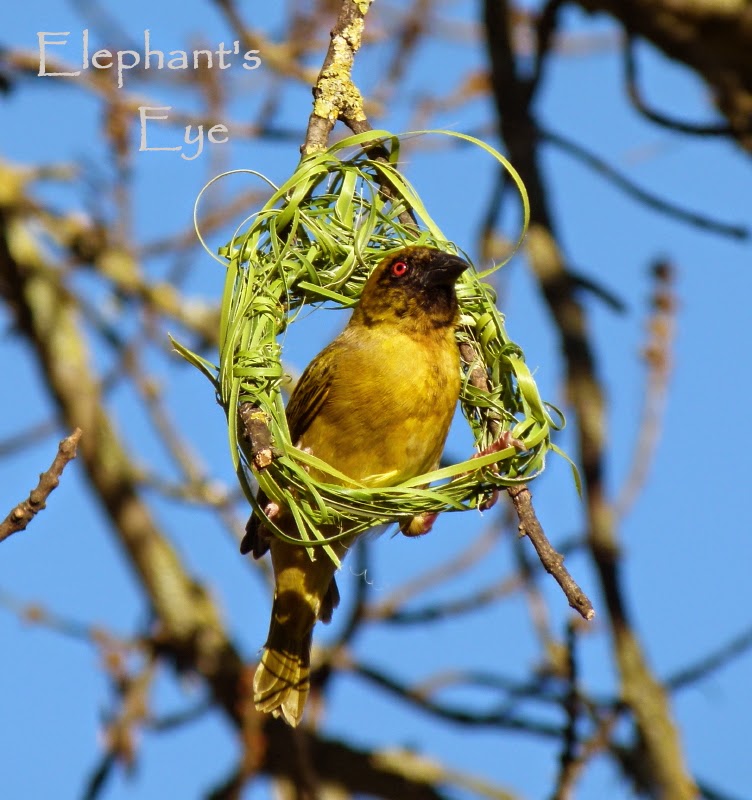
When we were looking for land and saw the reeds and the weavers busy with their nests - we knew we would build our house and make our garden here. This year a solitary pioneer has begun building his three nests within the walled garden on the ash tree. Now we can watch as the masked weaver ties the knots for the first loop, then stands within a 'hand' tied green garland. In days he has built a family home supported on that first loop.

Masked weaver in his 'hand' tied green garland


14 June, 2014

Striped mice and snowy mountains

by Diana Studer
- gardening for biodiversity

Chunks of grubbed out grape vines are arranged here to give wildlife, lizards and snakes… a place to live, to escape the cat. Looking out of the bedroom window, from where we can photograph in peace, I saw a striped mouse enjoying the early sunshine on a winter morning. Very alert, he dived back among the branches at the slightest sound or movement. He is conveniently at home next to the overspill from the bird feeder. Rhabdomys pumiliothe striped mouse lives in our fynbos and renosterveld.

Striped mouse looking this way


28 May, 2014

A Swartland Garden in May

by Diana Studer
- gardening for biodiversity

We've had a little tortoise puttering around. Kept rescuing him, from the driveway and the paths. Parking him at the succulent spekboom where he could reach. Tiny little legs can move. In minutes I've lost him and we forgot the photo! The geometric tortoise is protected. The eggs hatch with our winter rain (April or May). Grass herbs and shrubs are what they eat. Restricted to our corner of the Western Cape. 90% of their renosterveld habitat is gone to agriculture and urban sprawl. Unplanned wildfires and invasive alien plants are extra burdens on the few survivors.

Plum Creek in autumn's gold

23 April, 2014

A Swartland garden in April

by Diana Studer
- gardening for biodiversity

When we left Cape Town, passed thru the Wheat Curtain, and began gardening in the Swartland with its Renosterveld - I battled to find advice, or appropriately indigenous plants. I tried and failed with the fynbos plants I knew and loved. Only the Erica baccans survived that lesson. Now growing with determination across the path, NOT in the bed. If I would start again now ... I'd turn to the gardens and nurseries at Biodiversity and Wine Initiative wine estates for ideas and plants.

Yellow Tecoma capensis

10 April, 2014

Malgas lilies and Moutonshoek

by Diana Studer
- gardening for biodiversity

When the mains burst, we are prepared for no running water and Regular Service will resume shortly. I used nearly a litre of water to brush my teeth and wash my face. Focused my mind on Third World women or children who may spend 8 hours a day fetching water.

Malgas lilies near Moutonshoek in April 2012

03 April, 2014

Rain spiders Palystes sp.

by Diana Studer
- gardening for biodiversity

There are two forms of wildlife that make me shriek out loud. I have a totally irrational horror of grasshoppers, locusts. I will cross the road to avoid one. They don't bite. They don't hurt. But what if it would jump ON me. 

The second would be these rain spiders INside. I am OK if they are outside. We had one on the sliding glass patio doors. High up, towards the centre, near the opening. That evening I slid the doors open to tell M'sieur Chocolat the kitchen is about to close - Final Orders?! And something, large, walked very delicately, across my forehead. Well, my fringe, over my hair. As I drew breath to scream, I realised it was 'just' that rain spider. Disturbed in her evening hunting, by me, opening the door. 

Rain spider from above

26 March, 2014

A Swartland garden in March with a string of hearts Ceropegia woodii

by Diana Studer
- gardening for biodiversity

The string of hearts is Ceropegia woodii a tiny succulent creeper I grow in pots. Before blogs and the internet when I still read gardening magazines, I once asked if anyone had a bit of this plant for me. They came from all over South Africa. By post, and even a young woman on holiday from Durban who brought me a tiny pot from her granny in Kloof near Durban. Now my pots are tucked in the hanging gardens of Babylon around the Folie de MIIX and I forget to look at them. The plant family is Apocynaceae (with frangipani and Carissa), formerly Asclepiadaceae (with Hoodia, Hoya and Stapelia). Found across South Africa, and to Tanzania and Madagascar. The bushman's pipe flowers are to catch insects, but only for pollination, not lunch.

Ceropegia woodii

19 March, 2014

March lilies Amaryllis belladonna

by Diana Studer
- gardening for biodiversity

For Alice, and all my readers with March birthdays

Our garden year for South Africa begins in March. As the summer heat fades, and the autumn equinox approaches, the March lilies Amaryllis belladonna burst into an exuberant cancan. The days are shorter, the evenings at least are cool and kind to soft green leaves. In March Western Cape gardens heave a deep sigh of relief.

,
Jurg's March lilies in 2013

06 March, 2014

Fire on our mountain in March 2009

by Diana Studer
- gardening for biodiversity

Updated 22 December 2017 for Hessea monticola

If you live, as we do, and did in Camps Bay where mountain / wild / forest fires are a part of life. Then you will recognise that rising sense of unease. It was March 2009 and I could smell smoke – not a farmer burning the stubble (sadly they still do, despite global weirding), nor an insane neighbour burning garden waste or autumn leaves. The light was strange, hazy to the sun, because there was so much smoke in the air. Where was the fire? People shared what they knew, from the farmer up on the mountain and nature conservation officials to TV and newspapers.

Where's the fire?

Photographs and Copyright

Photographs are from Diana Studer or Jurg Studer.
My Canon PowerShot A490

If I use your images or information, it will be clearly acknowledged with either a link to the website, or details of the book. If you use my images or words, I expect you to acknowledge them in turn.


Midnight in Darkest Africa

Midnight in Darkest Africa
For real time, click on the map.