Showing posts with label bulbs. Show all posts

13 November, 2014

After our mountain fire, flowers

by Diana Studer
- gardening for biodiversity

November 2009 we returned to our burnt mountain. Since the March fire we had winter rain, and the mountain slopes were green, with unbroken drifts of colour from scarlet Watsonia. With the shrubs gone, annuals and bulbs celebrate their field day. Gradually the perennials and trees in the kloofs will grow back and crowd them out, until the next fire.

Ficinia radiata

27 August, 2014

A Swartland garden in August

by Diana Studer
- gardening for biodiversity

As August unfolds, the aloes open on our Karoo Koppie. The weaver birds bicker over whose turn it is for the nectar. Aloe marlothii  buds are little yellow bananas on maroon stems with prickly leaves. Aloe speciosa has red buds, which fade to white as it opens, with blue leaves. For False Bay I will be looking at Worcester's Karoo Desert National Botanical Garden for smaller aloes. Succulents like Euphorbia, Crassula and Cotyledon - which I'm harvesting for cuttings.

Yellow and red Aloe marlothii
Red and white Aloe speciosa


30 July, 2014

A Swartland garden in July

by Diana Studer
- gardening for biodiversity

Our garden decides which colour features thru the year. Red and yellow flames echo the kitchen hearth at the Owl House. I've learnt a deeper love for my blue-green Melianthus major as I see it cherished by Northern foreign gardeners. Theirs is cut down by frost, and mine is bravely cut to the ground, stalk by stalk as the seeds fall. Strelitzia is not only flame-coloured, but also flame-shaped.

Teeth on the leaves of Melianthus major
Strelitzia
 about to open

23 April, 2014

A Swartland garden in April

by Diana Studer
- gardening for biodiversity

When we left Cape Town, passed thru the Wheat Curtain, and began gardening in the Swartland with its Renosterveld - I battled to find advice, or appropriately indigenous plants. I tried and failed with the fynbos plants I knew and loved. Only the Erica baccans survived that lesson. Now growing with determination across the path, NOT in the bed. If I would start again now ... I'd turn to the gardens and nurseries at Biodiversity and Wine Initiative wine estates for ideas and plants.

Yellow Tecoma capensis

10 April, 2014

Malgas lilies and Moutonshoek

by Diana Studer
- gardening for biodiversity

When the mains burst, we are prepared for no running water and Regular Service will resume shortly. I used nearly a litre of water to brush my teeth and wash my face. Focused my mind on Third World women or children who may spend 8 hours a day fetching water.

Malgas lilies near Moutonshoek in April 2012

19 March, 2014

March lilies Amaryllis belladonna

by Diana Studer
- gardening for biodiversity

For Alice, and all my readers with March birthdays

Our garden year for South Africa begins in March. As the summer heat fades, and the autumn equinox approaches, the March lilies Amaryllis belladonna burst into an exuberant cancan. The days are shorter, the evenings at least are cool and kind to soft green leaves. In March Western Cape gardens heave a deep sigh of relief.

,
Jurg's March lilies in 2013

06 March, 2014

Fire on our mountain in March 2009

by Diana Studer
- gardening for biodiversity

Updated 22 December 2017 for Hessea monticola

If you live, as we do, and did in Camps Bay where mountain / wild / forest fires are a part of life. Then you will recognise that rising sense of unease. It was March 2009 and I could smell smoke – not a farmer burning the stubble (sadly they still do, despite global weirding), nor an insane neighbour burning garden waste or autumn leaves. The light was strange, hazy to the sun, because there was so much smoke in the air. Where was the fire? People shared what they knew, from the farmer up on the mountain and nature conservation officials to TV and newspapers.

Where's the fire?

09 November, 2012

Summer Southeaster swept into my garden

Our garden is in that dip, when the flowers and lush green of autumn winter and spring’s bulbs – are lying down in summer tans. Crumpled leaves are ready to be chopped and mulched for the next season’s flowers.

Agapanthus bud in morning sun at Ungardening Pond

13 April, 2012

April showers bring us flowers 2012


The noise of long hot dry days, has been broken by the clear signal of autumn. We can garden in shorts and T-shirt without desperately seeking shade. An Easter weekend which brought us a grateful soaking of 34 millimetres of rain.

Our Southern hemisphere mediterranean autumn, walks hand in hand with Northern gardeners delighting in spring. The garden is stretching gracefully. 

Lampranthus seedheads open in the rain

Walking on our Karoo Koppie I found flowers in a subtle range of colours. Wait, those should be a star-spangled lemon yellow in September! The vygie seedheads had opened in the rain.

25 November, 2011

Wildflower Wednesday and Dietes our wild iris

Gail at Clay and Limestone’s Wildflower Wednesday is usually my chance to walk around the garden – collecting what is blooming to attention. But they must be indigenous, native to South Africa. As I did last November. Today our wild iris Dietes will monopolise this WFW. It began life as part of my free seed allocation for members of the Botanical Society based at Kirstenbosch. Now it is SANBI South African National Biodiversity Institute  which hosts the PlantZAfrica site I like to use. Biodiversity e.g. barn swallow migration and climate change.

Dietes grandiflora

Dietes grandiflora has that American habit known as walking onions.

22 July, 2011

Inspired by Ifafa lilies

Last Saturday we went across-our-valley-to-Riebeek, to a new nursery. I will show the plants as they find their new homes in our garden. First the Ifafa lilies. Two bags filled with LOTS of bulbs, so I split them gently. Planted four clumps ‘under’ our baby lime tree. Now I sit on my little chair like Charlie Brown – to watch them grow into an Elizabethan ruff of singing-canary yellow!

Ifafa lily


10 June, 2011

Red, yellow and bare

The Western Cape on a good winter day. Not one of the cold wet grey days. But one of the lovely blue sky sunny days, walking thru our garden in June. Jeans and T-shirt midday.

Red aloes … on our Karoo koppie. That says winter to any homesick South African.

Pig's ears, red aloe


11 October, 2010

October, walk in our garden

At the bottom of a long narrow entrance, on the road we have a pair of olive trees. Brick piers. Not Stately Home Lions, cottage lions. We inherited the shocking pink watsonias with their graceful swan necks. But they have never looked this good before. This – is their year. We did plant the golden yellow Arctotis with the trailing silver leaves.

Entrance at the road


06 August, 2010

Vlei lilies in Plum Creek

At the edge of the wheat-fields and along the road side verges, where the farmers spray weed-killer and the authorities send out teams with ride on mowers. One of the plants they fight, in the boggy hollows where the winter rain collects, is this vlei lily. Wurmbea stricta


26 July, 2010

Deepest darkest Winter - flowers in July

It is the 25th. My day to walk around the garden and remind myself what is catching the eye this month. First the same old same old. Japanese flowering quince, a bush we inherited, halfway down the driveway, always blooms for my birthday. And for Anna's, who planted it. Usually blooms on spectacular bare branches, but this year, there are still leaves ...?


06 July, 2010

Stroll thru our garden with me

It is Saturday morning and you’ve dropped in for a quick cup of tea.


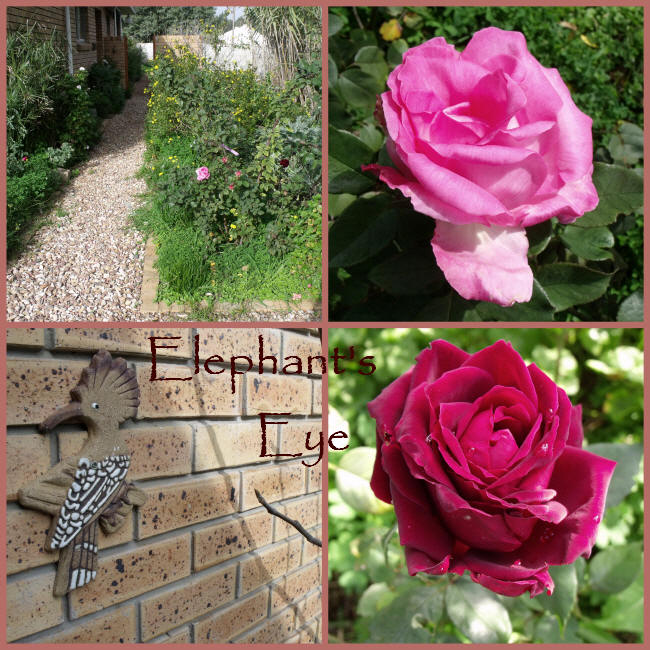
Bury your nose in pink Perfume Passion and deepest red Black Prince. See, the fig has lost its leaves, leaving a few tiny second crop figs, which will fall to the ground. The hoopoe, from niece Claire, came with us from the last house in Hoopoe Avenue. Where we saw no live hoopoes, to this town where we usually see some on our rare walks. We’re out in the garden, come thru the open garden gate.

26 May, 2010

MayflowerS

May in our garden is about two things. First the rain has brought BULBS bursting thru everywhere you look. Quite literally millions of Oxalis pes-caprae, wherever someone else didn't get in there first! If you've read here before, then you know I love foliage. Half my bulbs are chosen for their leaves, and the flowers are just a lovely bonus.


10 May, 2010

Ash tree planters

In the very beginning, there were two ash trees. Our trees are about thirty years old. A good reason for us to chose This plot. We call them Dolf and Anna, for the gardeners who left us these trees, fruit trees, bulbs and Anna’s Red rose. Also lots of spinach, which just comes up, like that, of its own accord.

2006 

I have learnt my lesson in the meantime. I thought, trees, shade, I’ll plant a woodland garden. Clivia. Plectranthus. A hardy fern. We didn’t want to upset the trees by digging into their roots or banking soil up against the trunk. We built planters, away from the trunk.

01 December, 2009

Pink Promise

My pink roses have lots of leaves, coming, and buds for later. But there are just two flowers on minature Lavender Jade. I choose to mix my roses with lots of other plants. Indigenous/native as a first choice. I use blue/glaucous foliage to set off the variety of pink shades. Any colour, so long as it is pink. The planting  plan

A variegated Tulbaghia adds some vitality.


25 October, 2009

Chincherinchees

We have the same farmer to thank, who gave us Melianthus (honey flowers) and Zantedeschia (arum lilies) along his stream. Who has built open sided sheds to give his dairy cows shade from the brutal summer heat, and they really appreciate it. We see them tidily arranged in the rectangle of shade, with one or two having a nibble, or a drink of water, or stretching their legs. This plant will kill cattle, so now I understand why those cows are firmly fenced away from this flower display.


Photographs and Copyright

Photographs are from Diana Studer or Jurg Studer.
My Canon PowerShot A490

If I use your images or information, it will be clearly acknowledged with either a link to the website, or details of the book. If you use my images or words, I expect you to acknowledge them in turn.


Midnight in Darkest Africa

Midnight in Darkest Africa
For real time, click on the map.