Showing posts with label birds. Show all posts

29 October, 2014

October roses and baby swallows

by Diana Studer
- gardening for biodiversity

I look at boxes. We will be leaving Elephant's Eye and Porterville in November. My last Wildflower Wednesday for Gail at Clay and Limestone from this garden of 8 years in our life. But always there are flowers, even if only two roses in jam jars.

Moving with Duftwolke and Karoo Rose

25 June, 2014

A Swartland garden in June

by Diana Studer
- gardening for biodiversity

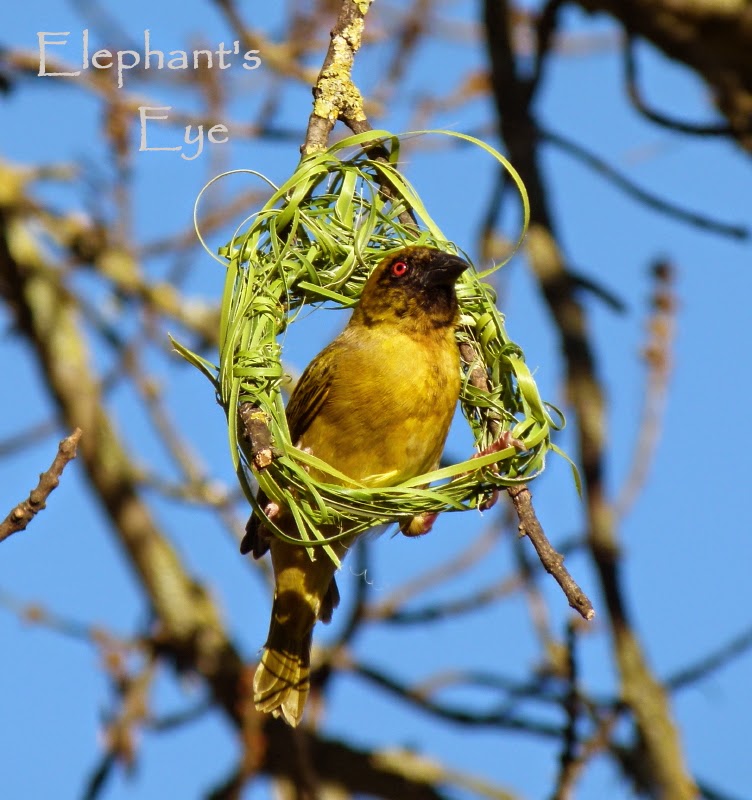
When we were looking for land and saw the reeds and the weavers busy with their nests - we knew we would build our house and make our garden here. This year a solitary pioneer has begun building his three nests within the walled garden on the ash tree. Now we can watch as the masked weaver ties the knots for the first loop, then stands within a 'hand' tied green garland. In days he has built a family home supported on that first loop.

Masked weaver in his 'hand' tied green garland


23 April, 2014

A Swartland garden in April

by Diana Studer
- gardening for biodiversity

When we left Cape Town, passed thru the Wheat Curtain, and began gardening in the Swartland with its Renosterveld - I battled to find advice, or appropriately indigenous plants. I tried and failed with the fynbos plants I knew and loved. Only the Erica baccans survived that lesson. Now growing with determination across the path, NOT in the bed. If I would start again now ... I'd turn to the gardens and nurseries at Biodiversity and Wine Initiative wine estates for ideas and plants.

Yellow Tecoma capensis

13 December, 2013

The policeman and the prima donna

by Diana Studer
- gardening for biodiversity in Porterville, near Cape Town in South Africa


We have no manicured lawn. We've learnt to adjust to a hotter summer, but still in the Western Cape’s familiar mediterranean climate. They say build it and they will come – and indeed they have!

The Story of Elephant’s Eye

Chapter 7
Gardening for biodiversity

We live in a small country town, our garden behind a wall. We have a few diamond panels at the base of the wall – for frogs and snakes and lizards and striped mice. Our wildlife is birds and smalls.

Rosyfaced lovebird dining out at Spirulino's

Most exciting was the endangered Black Stork for which we named the little island in Ungardening Pond. Porterville lies in a dip which was once a vlei, and I wonder how many generations back the frogs remember coming here. These summer nights towards Christmas the frog and cricket oompah band is in fine form.

06 September, 2013

Rain gardening

Once upon a time we walked down the panhandle, past the ash trees to the reed bed and the weaver’s nests. We were smitten.

Giant or Spanish reeds

The Story of Elephant’s Eye

Chapter 4
Rain Gardening against Winter Floods

29 June, 2013

Strawberry moon for Wildflower Wednesday

That supermoon was a ‘Strawberry Moon – This name was universal to every Algonquin tribe. In Europe they called it the Rose Moon. The relatively short season for harvesting strawberries comes each year in June’ – from Farmer's Almanac.

Supermoon, rising, slowly 


15 February, 2013

Well earned names


Wistfully looking back at how our garden grew. We garden for wildlife. The most spectacular wildlife in our walled small town garden flies in. The jewelled Malachite Kingfisher has returned to take lunch with us. No, I’ll pass on the frog’s legs thanks.

Malachite Kingfisher, visiting our garden
Thanks to my niece Claire - this young bird has a black bill,
which will turn red when he grows up

The Story of Elephant’s Eye
Chapter 2

Black Stork Island

13 July, 2012

Gardening for wildlife in a Cape winter

We garden for wildlife. If a tree falls in the forest, and no one is there to hear it, does it still make a sound? Between RL and gardening, rediscover your sense of wonder. Take time out, see what wildlife makes its home, or pauses, in your garden.

In Paradise and Roses both of our strelitzias have a flower open. I know our strelitzias are grown in California, I wonder if the hummingbirds use them as a nectar source? Strong stem and a bowl overflowing with nectar brings an impatient queue of  masked weavers and  Cape weavers.

Strelitzia reginae occurs naturally only in South Africa: eastern coast, from Humansdorp to northern KwaZulu-Natal in coastal bush and thicket. It grows along river banks in full sun, however sometimes it occurs and flowers on margins of forest in shade – from PlantZAfrica.

Weaver on Strelitzia

23 March, 2012

March wildflowers for birds


Altho I do garden for wildlife, it is not as a trained ecologist, this plant for that butterfly. We have a pond full of frogs for the visiting kingfisher. We have a smorgasbord of assorted bugs for the fiscal flycatcher. But the regular residents who delight me are the sunbirds. (Our equivalent to North America’s humming-birds). I think of red or yellow flowers, whose trumpets are filled with nectar. This Wildflower Wednesday post will be my place to record which garden flowers I see sunbirds on each month. And a nudge to find plants to fill the gaps in the diary!

Yellow Bietou, pond bulbs, fiscal flycatcher, salmon pelargonium
Yellow Bietou, pond bulbs
fiscal flycatcher, salmon pelargonium


08 July, 2011

For the birds

The Ungardener loves Ungardening, pottering, DIY projects. If not a new one, then tweak the old. 

At the bird feeder

28 June, 2011

From fynbos fairies to mud

There are no fairies at the bottom of our garden. Perhaps a solitary fynbos fairy? 

A weaver with the sparrows

24 June, 2011

June wildflowers, birds and bees

When I reread Tuesday's poem, I found japonica and bees. Fitting in to my post for Wildflower Wednesday in Pollinator Week. Today's plants are all indigenous to South Africa in the spirit of Gail at Clay and Limestone's meme, EXCEPT the Japanese flowering quince and the fig and ash trees.

Listen to Henry Reed himself reading his poem, with Frank Duncan (as the lecturer). How strangely wonderful is modern technology! This is from a BBC broadcast in 1966. Text found at solearabiantree.

 
NAMING OF PARTS

To-day we have naming of parts. Yesterday,
We had daily cleaning. And to-morrow morning,
We shall have what to do after firing. But to-day,
To-day we have naming of parts. Japonica
Glistens like coral in all of the neighboring gardens,
          And to-day we have naming of parts.

Japanese flowering quince
with bee
LAST June, today is winter, grey wet and cold.

15 April, 2011

Life returns to Ungardening Pond

Little by little we are refilling the pond, after relining it. And how immediately life returns. The frogs have been with us, their lives lived out hunting crickets in the mulch layer we try to cover the garden in. A blur of movement, and a frog emerges as the watering can shower disturbs him. We heard reed frogs clicking in the afternoon, frogs croaking and raucous toads bellowing at night. Now there are tadpoles, drawing back our kingfishers (waiting on better pictures, but the birds are back at long last)

Ungardening Pond in autumn


08 April, 2011

Spirulino our rescued sparrow and friends

EDITED January 2014
by Diana Studer
- gardening for biodiversity

Found at the recycling depot in January 2010. The Ungardener has been helping to sort at the town’s fledgling recycling project. There he saw a little bird hopping around. He brought him food and water. But he sees there is something wrong with his wing. He cannot fly. When the door was open, out he hopped to the open field.  Not sure if the wing is broken. Or something attacked and injured him. He brought him home. He is a commonorgarden house sparrow. Invasive from Europe. Our bird book says they were first seen in Piketberg in 1962.

Spirulino's home

21 January, 2011

Fruit of the Mediterranean

Checking where, which site, my blog visitors came from, I fell over gimcw??? Gardening in mediterranean climates worldwide. They have added me to the gimcw list of blogs. One of my earliest comments was from a Spaniard – ho ho ho a Mediterranean garden way down South at the bottom of Africa! So yes, thank you, for a lower-case-mediterranean!

For years, ever since it was just an idea, I have wanted to visit the Eden Project in Cornwall. Was fascinating to see mediterranean plants from around the world gathered together, where I could see the actual growing plants. Not just a dry list of names, nor even frozen pictures. There I learnt that my lemon verbena comes from South America. Mexican born Fer in Japan (currently hosting a blog carnival) has promised to find us some good South and Central American garden blogs. Company for our lemon verbena, granadilla (South American, that's why I can't spell it) and guava.

A sparrow and weaver sharing our figs

18 January, 2011

Sunbirds, malachite and collared

We have planted Melianthus in our new False Bay garden. Waiting for the sunbirds to find it.

Return to October November last year. There were young sunbirds. We have two obvious sorts. The large green ones are the malachite sunbirds. Striking for two reasons. First they are twice as big, 24 cm, as their smaller 12-14 cm cousins. Then they go for the shimmering malachite green all over.

Malachite sunbird

15 November, 2010

An egg, young birds and photos by GINKs

We see and hear many young birds now. Teenagers who with their fluffy feathers are anyway bigger than mum and dad. Standing there with open beak, shimmying their wings. Yelling Feed Me Now!

European starlings bringing caterpillars


27 October, 2010

Fiscal shriek, sorry, shrike

Jacky Hangman. Dressed in black and white. As the judge used to wear a black hood, when sentencing a prisoner to death. Yesterday the sparrows, weavers and starlings were spinning in distraught circles. Why?

Fiscal shrike


19 October, 2010

First day with his new camera

He is in his element. Trying out the new to him features one by one. Panasonic Lumix FZ100. U3A photographers sit while waiting for the birds to fly in and out.

First day with new camera


27 September, 2010

Photographing birds, in our garden, mostly

If a black stork lands in our garden and we don’t see it, was it really there? This was our wildlife garden’s shining moment. My birding niece said Never Seen One of Those! We wouldn’t have known there were black storks – if we hadn’t seen this one here.
 (On the verandah, about 7 metres from the bird on the island.
 Taken with the dear departed Old Canon.)

Black stork


Photographs and Copyright

Photographs are from Diana Studer or Jurg Studer.
My Canon PowerShot A490

If I use your images or information, it will be clearly acknowledged with either a link to the website, or details of the book. If you use my images or words, I expect you to acknowledge them in turn.


Midnight in Darkest Africa

Midnight in Darkest Africa
For real time, click on the map.